Reintroducing two hours of free on-street short-stay parking to support central city revitalisation
Council is proposing to reintroduce two hours of free on-street short-stay parking in the central city.
Under the proposal Council is consulting on, the first two hours of on-street short-stay parking in the central city would be free. The current green and yellow parking zones would be merged and the third and subsequent hours of paid parking would be set at one simple hourly rate of $6 per hour.
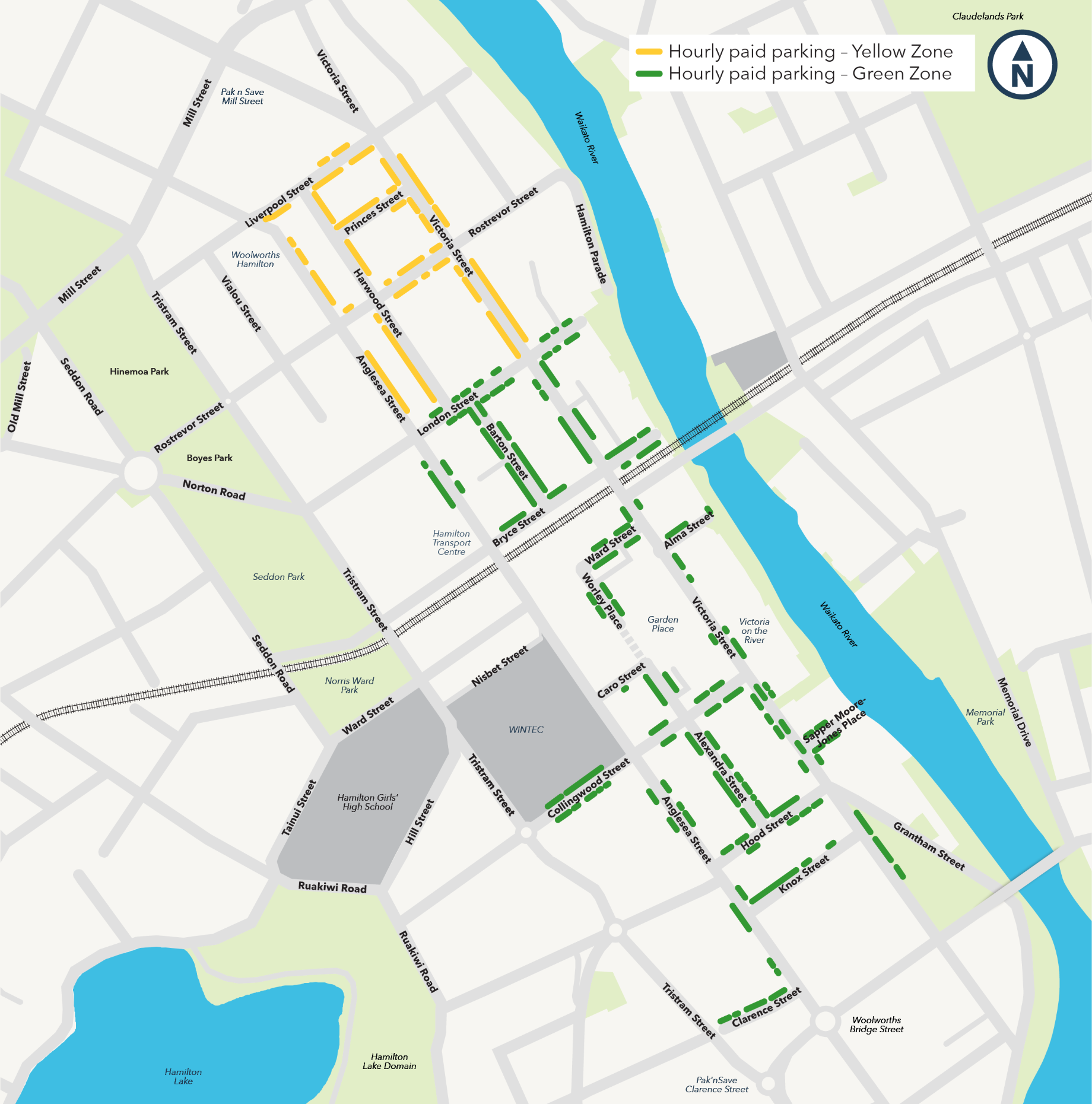
If two hours of free parking is not reintroduced, there are two alternative options. Council could keep one hour of free on-street short-stay parking or proceed with removing all free on-street short-stay parking entirely.
With the one-hour free parking option
The current green and yellow zones would be merged and the second and subsequent hours of paid parking would be set at one simple hourly rate of $6 per hour.
With the no free parking option
The green and yellow zones would remain. In green zone, the first two hours would be $3 per hour and then $6 per hour for any additional time. In the yellow zone, the first two hours would be $1 per hour and then $6 per hour for any additional time.
| Two-hours free (Council's preferred option) | One-hour free | No free parking |
|---|---|---|
| Returning to two hours of free on-street short-stay parking in central city would result in Council not receiving an estimated $793,000 of refenue compared to the no free parking scenario (this estimated revenue shortfall is based on parking consumption levels from April to September 2024, when two-hours free was previously in place). $793,000 of revenue is the equivalent of 0.3% of rates. | One hour of free on-street short-stay parking in central city would result in Council not receiving an estimated $458,000 of revenue compared to the no free parking scenario (this estimated revenue shortfall is based on parking consumption levels from April to September 2024, when two-hours free was previously in place). Compared to two hours of free parking, Council would not receive an estimated $335,000 of revenue. | The removal of free parking would result in Council receiving an additional $793,000 in revenue compared to two-hours free parking, or an additional $458,000 compared to one-hour free parking. |
When the two-hour free parking trial was previously in place, Council introduced a central city rate to offset some of the costs of free parking. This is due to be removed on 30 June 2026, and this proposal does not change this.
| Option 1: Mayor’s proposal: two hours on-street short-stay free parking from 1 July 2026 in a single zone | |
|---|---|
| Benefits | Disbenefits |
| ● Can provide incentive for people to visit the central city. | ● May have an unintended consequence of employees or tradespeople utilising spaces while working more frequently. |
| ● May increase spending in the central city. | ● Parks are more likely to be occupied at higher levels, reducing parking turnover and resulting in it being harder to find a car park. |
| ● May support those accessing social services in the central city. | ● May require additional staff resourcing to ensure compliance, taking staff away from other areas across the city. |
| ● Can provide certainty for short-stay parkers to enjoy shopping and hospitality and access other services. | ● Infringement notices may increase for non-registering of vehicles to activate the two hours free. |
| ● Would be consistent across all on-street short-stay car parking and remove confusion around parking zones. | ● May have a small impact on privately owned parking buildings. |
| ● Additional hours would provide revenue through setting appropriate fees and charges. | ● $790,000 in reduced revenue compared to the removal of free parking. |
| ● May encourage private car use, at odds with Council's Access Hamilton and Climate Change. | |
| Option 2: 2024-34 Long-Term Plan decision: remove free on-street short-stay parking entirely from 1 July 2026 | |
| Benefits | Disbenefits |
| ● Consistent with some privately owned parking buildings where parking charges apply. | ● May be a disincentive for people to visit the central city. |
| ● Infringement notices likely to decrease for non-registering of vehicles. | ● May decrease spending in the central city. |
| ● Parks are more frequently vacated resulting in it being easier to find a park (compared to two hours free). | ● May not support the proposed revitalisation of the central city. |
| ● Will be consistent across all on-street short-stay car parking and remove confusion around parking zones. | ● Inconsistent with what has been signalled through The Mayor’s Plan 2025-28. |
| ● Will provide revenue through setting appropriate fees and charges. | ● May generate confusion and frustration around the cost of on-street short-stay parking, given the use of demand-responsive pricing. |
| ● Can be managed through existing resourcing. | |
| ● May support greater use of public transport and active travel modes. | |
| Option 3: Continue with one hour of free parking | |
| Benefits | Disbenefits |
| ● Can provide incentive for people to visit the central city. | ● Parks are more likely to be occupied at higher levels, reducing parking turnover and resulting in it being harder to find a car park. |
| ● May increase spending in the central city. | ● May require additional staff resourcing to ensure compliance, taking staff away from other areas across the city. |
| ● Can provide certainty for short-stay parkers to enjoy shopping and hospitality and use other services. | ● Infringement notices may increase for non-registering of vehicles to activate one-hour free. |
| ● Would be consistent across all on-street short-stay car parking and remove confusion around parking zone. | ● May have a small impact on privately owned parking buildings. |
| ● Additional hours will provide revenue through setting appropriate fees and charges. | ● Some anecdotal evidence that people consider one hour too short. |
| ● Parks could be more frequently vacated resulting in it being easier to find a park (compared to two hours free). | ● May be a disincentive for people to visit the central city or only stay for the duration of their free parking resulting in decreased spending. |
| ● $458,000 in reduced revenue compared to the removal of free parking. | |
| ● May encourage private car use, at odds with Council's Access Hamilton and Climate Change strategies. | |
Increasing the entry price for non-Hamiltonians aged 16 and over to access the Enclosed Gardens at Hamilton Gardens
Hamilton Gardens is an internationally recognised and award-winning destination, most well-known for the 18 themed Enclosed Gardens.
In September 2024, Council introduced an entry price for the enclosed gardens at Hamilton Gardens of $20 for non-Hamiltonians aged 16 and over. From 1 October 2026, Council is proposing to increase the entry price to $27.50. Entry would remain free for Hamilton residents and ratepayers, and anyone under 16 years of age.
Everyone, no matter where they live, will continue to have free access to the wider gardens which include Roger’s Rose Garden, Rhododendron Lawn, Camellia Garden, the children’s playground, Turtle Lake, carparks and Hamilton Gardens Café.
Council’s research shows the Enclosed Gardens entry price remains at the lower end of visitor attraction pricing in New Zealand. The $27.50 entry price aligns with the adult entry price for Hamilton Zoo, and means Council has consistent entry prices across its premier visitor attractions.
The increase to the entry price is expected to lead to a decrease in domestic visitors paying to access the Enclosed Gardens. However, there is minimal expected impact on international visitor numbers.
Council estimates the increase in entry price would result in $550,000 – $900,000 more revenue per year. These numbers have factored in a 5% – 15% reduction in visitors. The increased revenue will reduce the overall cost of the Gardens to Council.
Planning Guidance/Urban and Spatial Planning fees and charges
All but three Planning Guidance and Urban and Spatial Planning fees and charges are proposed to increase by a range of 2.5% – 3.4%. The other three fees and charges increasing by more than this range are increasing by $1. See the Planning Guidance and Urban and Spatial Planning fees and charges.
Have your say!
Thank you for your interest. The opportunity to provide feedback closed 3 May 2026.