What are we proposing?

Hamilton City Council is proposing to reduce the speed limit on a 460m stretch of Te Rapa Road, between Hutchinson Road and State Highway 1C (SH1C), from 80km/h to 60km/h.

This section of road will soon include a new signalised pedestrian crossing.

The crossing is required as part of the approved Te Awa Lakes development and must be built.

What we are asking for your feedback on the speed limit through this short stretch of road once the crossing is in place.

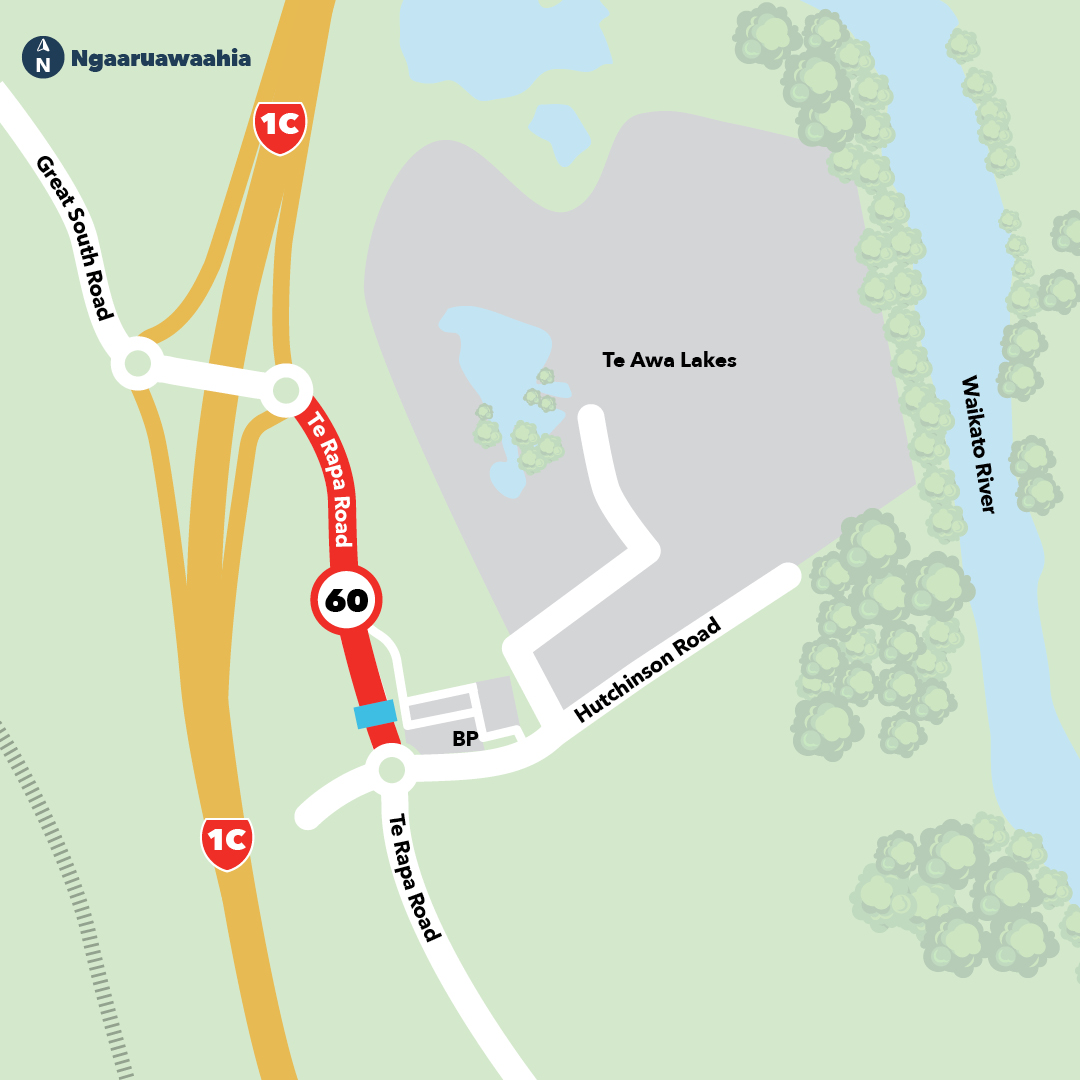
The map below shows:

  • The section of Te Rapa Road proposed for the speed limit change – shown in red
  • A new signalised pedestrian crossing to be installed by Te Awa Lakes as a requirement of their resource consent – shown as a blue rectangle.

Map shows section of Te Rapa Rd proposed for speed limit change (in red) and new signalised pedestrian crossing (blue rectangle)

Why are we proposing a speed limit reduction?

Te Awa Lakes is a new neighbourhood being developed at the northern end of the city. Stage one includes around 80 homes, with up to 2,500 homes planned over time. Families will begin moving in from mid-2026. You can find out more about Te Awa Lakes on their website teawalakes.co.nz.

As part of the approved development, a signalised pedestrian crossing must be installed on Te Rapa Road between Hutchinson Road and State Highway 1C. This is a requirement of the resource consent and is not being reconsidered.

Te Awa Lakes will fund the full installation of the crossing in accordance with consent conditions.

With more residents living in the area, there will be more people walking, cycling, and catching the bus. Council is considering whether the current 80km/h speed limit remains appropriate once the signalised crossing is in place, or the speed limit of the 460m section between Te Rapa Road between Hutchinson Road and SH1C speed is reduced to 60km/h.

Lowering the speed limit to 60km/h on this short stretch of road should:

  • Reduce the risk and severity of crashes
  • Improve safety for people using the crossing
  • Support safer access to nearby bus stops
  • Provide a safer environment for the growing community

However, any change may also mean a small increase in travel time – estimated at around five seconds per vehicle.

Key considerations

  • A signalised pedestrian crossing must be installed as part of the resource conditions of the Te Awa Lakes development
  • The cost of installing the signalised pedestrian crossing is being fully funded by Te Awa Lakes development
  • Council is responsible for consulting on the options to change the speed limit from 80km/h to 60km/h
  • If the speed limit is reduced, Council is responsible for replacing the speed limit signage in the area
  • If Council decide to reduce the speed limit, the changes will still require approval from the Director of the New Zealand Transport Agency (Waka Kotahi).

Road and extent of changes Te Rapa Road – between Hutchinson Road and State Highway 1C (SH1C)
Existing speed limit 80km/h
Proposed speed limit 60km/h
Street category based on the Land Transport Rule: Setting of Speed Limits 2024 Rural Connector
Distance
460m
Crashes in the last five years 2 minor injury and 5 non injury crashes
Estimated reduction in number and severity of crashes – average over five years 0.5 less minor injury crashes
1.2 less non injury crashes
Current mean operating speed 64km/h
Estimated Impact per vehicle 5 seconds per vehicle
Estimated collective impact based on average annual daily traffic volumes (AADT) 3,121 hours per year over 2.78 million vehicle movements (7,614 AADT)
Cost to implement the change including consultation and installation $5,000 for consultation and reporting, $30,000 for new signage and road marking.

Note: the above information has been prepared using the NZ Transport Agency Optional Cost Impact Analysis tool.

Options

Council is providing two options for the community to give feedback on.

  • Option 1 (proposed): Reduce the speed limit from 80km/h to 60km/h.

    Reducing the speed limit would mean:

    • Improved safety for people using the new pedestrian crossing and accessing the nearby bus stops
    • A reduced risk and severity of crashes
    • A lower cost to the developer to install the pedestrian crossing
    • The installation and maintenance of new speed limit signage – at Council’s cost
    • A safer environment for the growing community.
  • Option 2 (status quo): Keep the speed limit at 80km/h.

    Not changing the speed limit would mean:

    • It is more dangerous for pedestrians with vehicles potentially travelling at higher speeds
    • A higher cost to the developer for installing the signalised pedestrian crossing, as this option requires additional detector loops and linking cabling.

Tell us your thoughts on the speed reduction

The survey should take less less than 5 minutes to complete.

Before making any final decisions, we’d like your input.

Next steps

Staff will collect and analyse all feedback at the close of the submission period.

The analysis of this feedback will be presented to the Transport Subcommittee on 26 May 2026. At this meeting, submitters who wish to provide a verbal submission to the Council will be able to do so.

Following consideration of all views received, the Council will then make a decision on the proposed speed limit reduction. If a decision cannot be reached at the Transport Subcommittee meeting, Councillors have the option to refer the decision to the City Delivery Committee or Ordinary Council meeting.

If Council decide to reduce the speed limit, the changes will still require approval from the Director of the New Zealand Transport Agency (Waka Kotahi).