Overview
This option would focus on targeted safety improvements at the highest demand crossing area near HBHS while retaining most existing on street parking and minimising wider corridor changes.
It would include time limited parking on Peachgrove Road such as short-stay 10-minute or 15-minute parking, and install ‘no U-turn’ signs.
It would not include bus infrastructure improvements.
Indicative cost: $1.05 million with a ground-level crossing
- (or $1.2 million with a raised pedestrian and cycle crossing)
Click the image to view full size
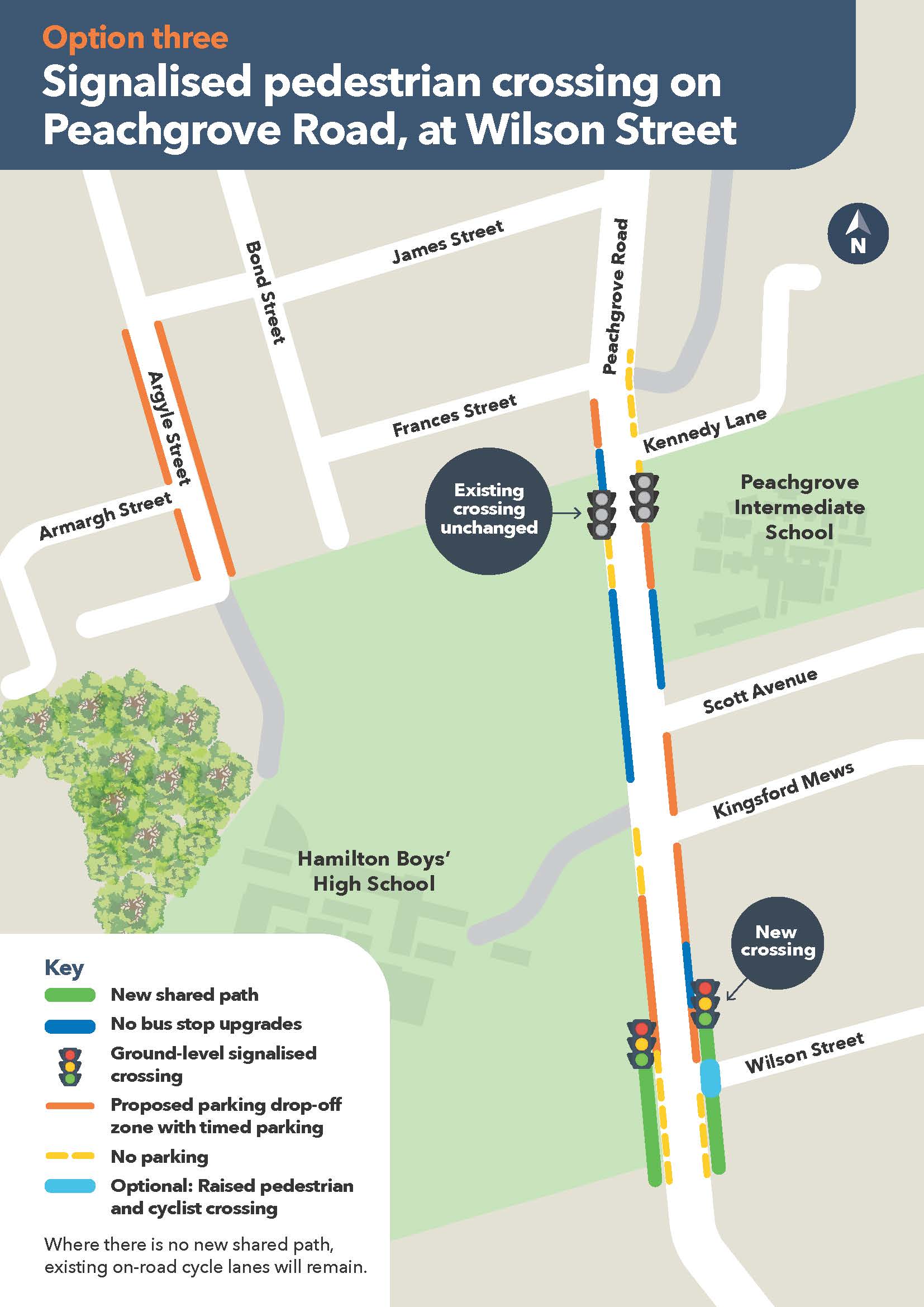
Key features:
- Short shared path (100m).
- One new signalised pedestrian crossing near Wilson Street.
- Two parking enforcement cameras.
- Retaining 47 short-stay carparks and removing five along this section.
- Optional: Raised pedestrian and cyclist crossings at Wilson Street entrance (additional cost).
| Benefits | Things to consider |
| Would provide a targeted safety improvement, addressing safety concerns at the busiest crossing point on Peachgrove Road (near Wilson Street). | Lower upfront cost compared to Option 1 and Option 2. |
| Would retain most existing parking on Peachgrove Road, reducing traffic impacts on side streets. | Lack of separated shared path would mean students cycling and scooting must continue to use the footpath or road. |
Time-limits on parking (during peak school hours only) and parking enforcement cameras for Peachgrove Road:
| Retaining on-street parking on Peachgrove Road, means congestion caused by parking on the main road would remain an issue. |
| Installing ‘no U-turn’ signs may discourage some risky U-turn manoeuvres. | Installing ‘no U-turn’ signs are less effective at discouraging unsafe driving behaviour compared to changing road layout. |
| Less disruption during construction compared to Option 1 and Option 2. | This option does not include upgraded bus infrastructure. |
| Construction impacts will cause temporary delays/disruption. To minimise disruption, most construction would be in January 2027 when schools are closed. | |
| Unspent funding allocated to this project would go back to Elected Members for a decision on whether to save it or reallocate it to other transport projects. Additional corridor wide improvements in this area would require future budgeting decisions. |